Lunar Eclipse in South Africa on 28 August
After the total lunar eclipse in early March this year, South African sky gazers will have another chance to experience the magical lunar eclipse phenomenon at the end of August!
In the early hours of Friday morning 28 August, we can experience a spectacular deep partial lunar eclipse in which around 96 per cent of the Moon’s visible disc will be inside Earth’s dark shadow at maximum eclipse. Although it will not technically be a total lunar eclipse, it may look very close to one.
Vox Weather Meteorologist Michelle du Plessis tells us everything we need to know, including the all-important weather forecast details.
What is a Lunar Eclipse?
The first point to note is that a lunar eclipse can only happen during a full moon.
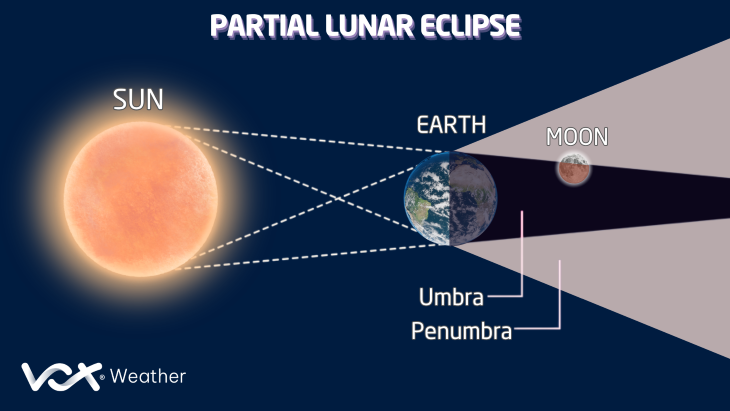
A lunar eclipse happens when the Earth moves between the Sun and the Moon, causing Earth’s shadow to fall across the Moon.
In simple terms:
- The Sun shines towards Earth.
- The Moon moves behind Earth.
- Earth blocks some of the sunlight that normally lights up the Moon.
- As a result, part or all of the Moon becomes darker.
- When all of the Moon becomes darker, we have a total lunar eclipse.
Is This a Total Lunar Eclipse?
The eclipse on 28 August will be a deep partial lunar eclipse, and not a total lunar eclipse.
This means that most of the Moon will enter Earth’s darkest shadow, known as the umbra, but a small part will remain outside it.
At maximum eclipse, about 96.2% of the Moon’s visible disc area will be inside the umbra. The eclipse has an umbral magnitude of about 0.93, meaning the umbra reaches across roughly 93% of the Moon’s diameter. These numbers describe two different measurements.
What Time Does the Eclipse happen in South Africa?
The eclipse takes place during the early morning of Friday, 28 August.
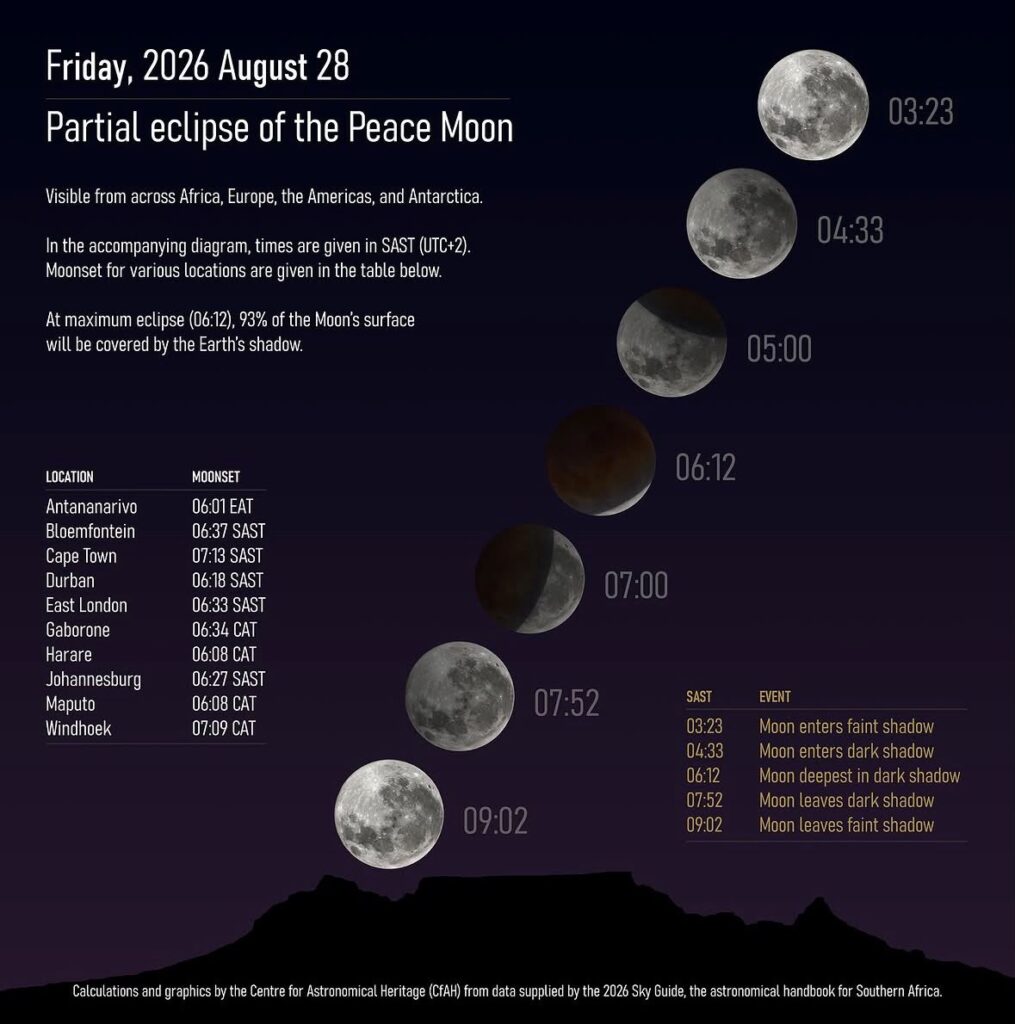
The main times in South African Standard Time are:
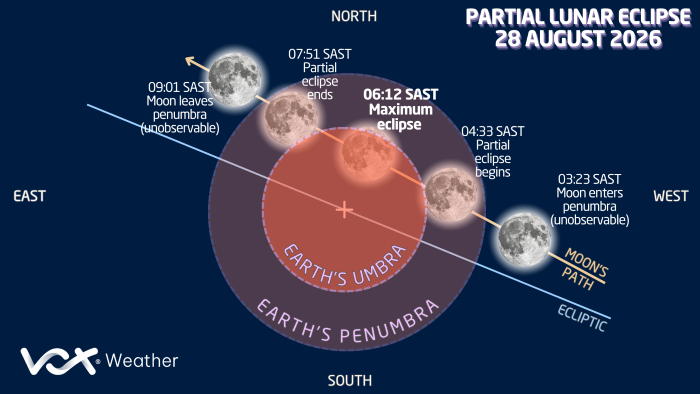
- Penumbral eclipse begins: 03:23
- Partial eclipse begins: 04:33
- Maximum eclipse: 06:12
- Partial eclipse ends globally: 07:51
- Eclipse ends completely: 09:01
South Africans will not see the final stages because the Moon will set before the eclipse is over.
For most viewers, the best time to start watching will be from around 04:30.
What Happens During Each Stage?
Stage 1:
The eclipse begins at 03:23: The Moon first moves into the lighter outer part of Earth’s shadow, known as the penumbra. At this stage, the Moon will only become slightly dimmer. This change can be difficult to notice with the naked eye.
Stage 2:
The main eclipse begins at 04:33: The Moon then starts entering Earth’s darker central shadow, called the umbra. This is when the eclipse becomes much easier to see. A dark curved shadow will slowly move across the Moon, almost as though a bite is being taken out of it.
Stage 3:
Maximum eclipse occurs at 06:12: This is the deepest point of the eclipse. Around 96% of the Moon’s visible disc will be inside Earth’s dark shadow, leaving only a small portion brightly illuminated. This should be the most dramatic stage of the event.
Why Might the Moon Look Red?
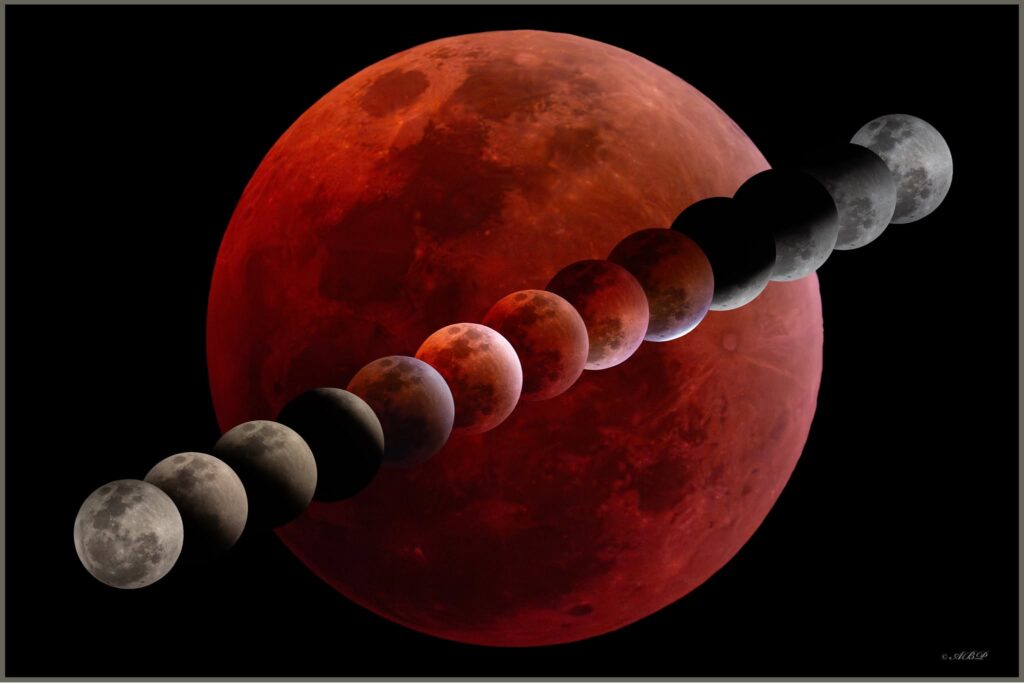
The Moon may take on shades of red, orange or copper during the deeper stages of the eclipse. This happens because some sunlight passes through Earth’s atmosphere and is bent into Earth’s shadow before reaching the Moon.
Earth’s atmosphere scatters much of the blue light, while more of the red and orange light passes through. It is the same basic reason that sunsets often appear red or orange.
So instead of the Moon simply disappearing into darkness, the eclipsed part may appear dark red, copper or brown.
Image below: Courtesy of Angus Burns Photography Angus Burns Photography – Mullers Pass, Newcastle, KwaZulu-Natal, 7 September 2025
Where Should You Look?
Look towards the western horizon.
The Moon will be setting in the west while the eclipse is approaching maximum.
This means viewers should try to find:
- An open area
- A clear view towards the west
- As few buildings or trees as possible
- A location without mountains blocking the western horizon
This becomes especially important closer to 06:00, when the Moon will be quite low in the sky.
Which Parts of South Africa Will Have the Best View?
The western parts of South Africa will generally have the best view near maximum eclipse. This is because the Moon will remain higher above the horizon for longer in the west.
Approximate conditions at maximum eclipse at 06:12:
- Cape Town: Moon around 11° above the horizon
- Bloemfontein: Moon around 4° above the horizon
- Pretoria: Moon around 2° above the horizon
- Durban: Moon less than 1° above the horizon
Approximate moonset times are:
- Cape Town: 07:12
- Bloemfontein: 06:36
- Pretoria: 06:25
- Durban: 06:17
This means people in Cape Town and the western parts of the country should have a much better chance of seeing the Moon around maximum eclipse.
In the eastern parts of South Africa, viewers should start watching earlier rather than waiting until 06:12.
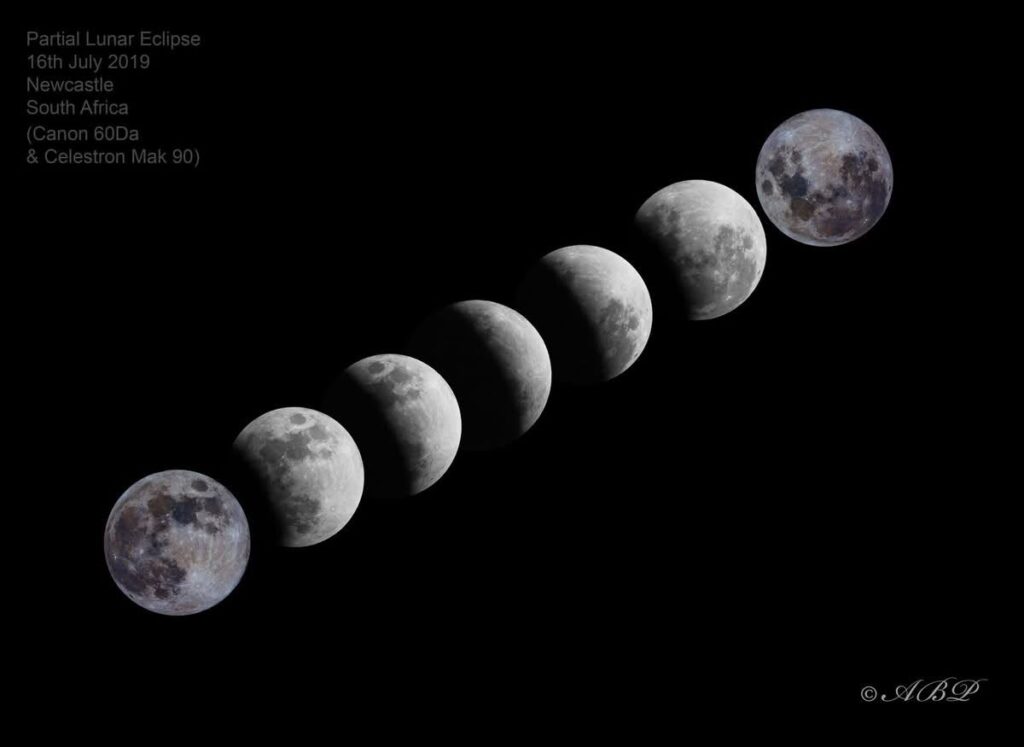
The image below, courtesy of Angus Burns Photography, reflects a partial lunar eclipse sequence on 16 July, 2019.
Why Will the Moon Be So Low?
The eclipse takes place shortly before sunrise in South Africa. As the morning progresses, the Moon will move lower towards the western horizon while the Sun approaches sunrise in the east.
So there are two things working against viewers later in the eclipse: the Moon becomes lower in the sky and the sky becomes brighter as sunrise approaches This is why the earlier stages of the partial eclipse could actually be easier to see in eastern South Africa than the moment of maximum eclipse.
Do You Need Eclipse Glasses?
No – a lunar eclipse is completely safe to look at with the naked eye. You do not need eclipse glasses because you are looking at the Moon, not directly at the Sun.
What Could Make the Eclipse Difficult to See?
Weather will be the biggest factor.
Even if skies are mostly clear, the Moon will be low near the western horizon, which means conditions close to the surface could make viewing difficult.
Things to look out for are cloud cover, low cloud, fog, haze and mountains or buildings along the western horizon. The eastern parts of the country will be particularly sensitive to poor visibility because the Moon will be extremely low by maximum eclipse.
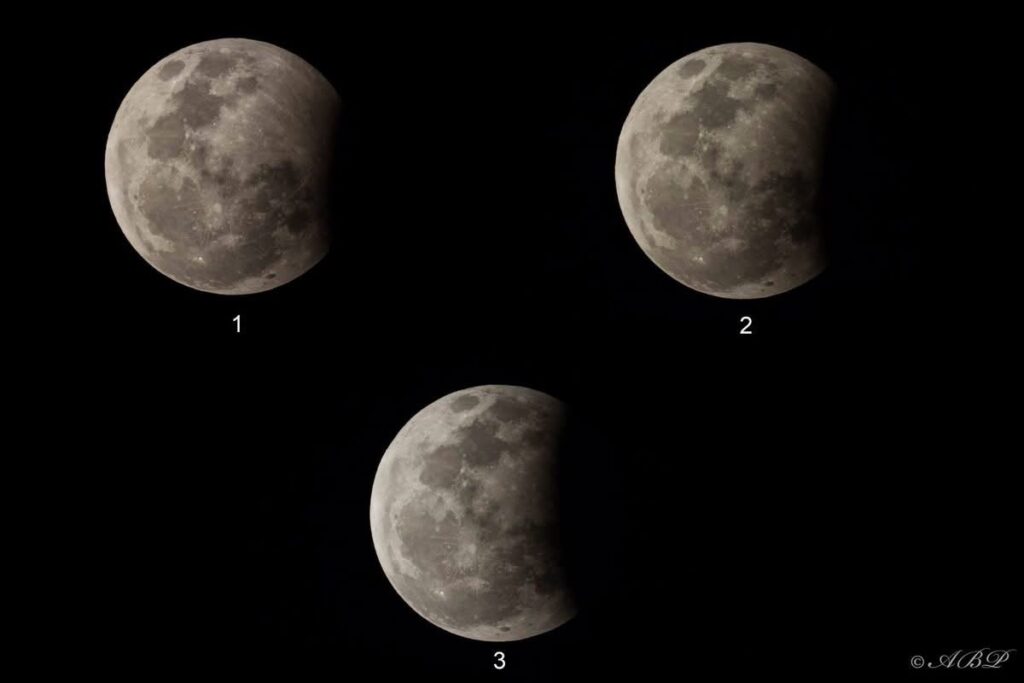
The image below, courtesy of Angus Burns Photography, shows phases of a partial lunar eclipse that took place in 2017.
Weather Outlook for SA’s Partial Lunar Eclipse
South Africans hoping to catch a glimpse of the partial lunar eclipse early on Friday morning, 28 August, will experience very different viewing conditions depending on where they are in the country.
Cloud cover will be the biggest deciding factor. While some areas are expected to have mostly clear skies, others could struggle with low cloud, fog and thicker cloud around the time of the eclipse.
Western Cape:
- Viewing conditions are not looking particularly favourable over the Western Cape. Mostly cloudy conditions are expected, with fog possible in places, particularly around Cape Town and the south-western parts of the province. This means the chances of seeing the eclipse are currently low in these areas.
Northern Cape:
- The interior of the Northern Cape currently has some of the best viewing prospects in the country. Little cloud cover is expected across much of the interior, giving residents a good chance of seeing the eclipse. Along the coast, cloudy conditions are expected, resulting in low viewing chances.
Eastern Cape:
- Conditions are more mixed over the Eastern Cape. Mostly cloudy skies are expected around Gqeberha, where viewing chances will be low. Conditions improve further east, with partly cloudy skies expected around East London, giving viewers a fair chance of catching the eclipse through breaks in the cloud.
Free State:
- Partly cloudy conditions are expected across parts of the Free State, including around Bloemfontein. Some breaks in the cloud are expected, giving the province fair viewing chances.
North West:
- Mostly clear to partly cloudy conditions are expected over much of North West. Overall, viewing chances look good, particularly where cloud cover remains limited during the early morning.
Gauteng:
- Gauteng is expected to be partly cloudy during the eclipse. Despite some cloud, enough clear breaks are currently expected to give much of the province good viewing chances.
Limpopo:
- Conditions are less favourable over Limpopo. Cloudy conditions are expected in places, with fog also possible, particularly towards the escarpment. This could significantly reduce visibility, resulting in low viewing chances.
Mpumalanga:
- Cloudy and foggy conditions are also expected in places over Mpumalanga, particularly along the escarpment. Viewing chances are therefore expected to be low in these areas, although locations farther away from the escarpment may experience some clearer breaks.
KwaZulu-Natal:
- KwaZulu-Natal currently has fairly favourable conditions, particularly along the coast. Mostly clear skies are expected along coastal areas, including around Durban, providing good viewing chances. The interior will be partly cloudy in places, with viewing chances depending on local cloud cover.
Where Are the Best Viewing Chances?
At this stage, some of the best viewing conditions are expected over the Northern Cape, North West and along the KwaZulu-Natal coast, with Gauteng also looking promising.
The Western Cape, Limpopo and parts of Mpumalanga currently have the poorest viewing prospects due to cloud and fog.
The Moon will also be very low towards the western horizon during the later stages of the eclipse. Even where skies are clear, viewers will therefore need an unobstructed view towards the west.
If the weather plays along, the early morning of 28 August should offer South Africans an impressive view as almost the entire full Moon slips into Earth’s shadow shortly before sunrise.
Happy sky gazing!
The infographic below is courtesy of the Centre for Astronomical Heritage and the 2026 Sky Guide.