May 2026 will always be remembered as being one of the most remarkable weather months in recent Western Cape and Southern Cape history. Vox Weather Meteorologist Michelle du Plessis shares the seasonal outlook for winter 2026.

Please note: All graphs and images are taken from the latest Langtermyn Landbou-Weervoorspelling, and you can also view the current seasonal Landbou show here.

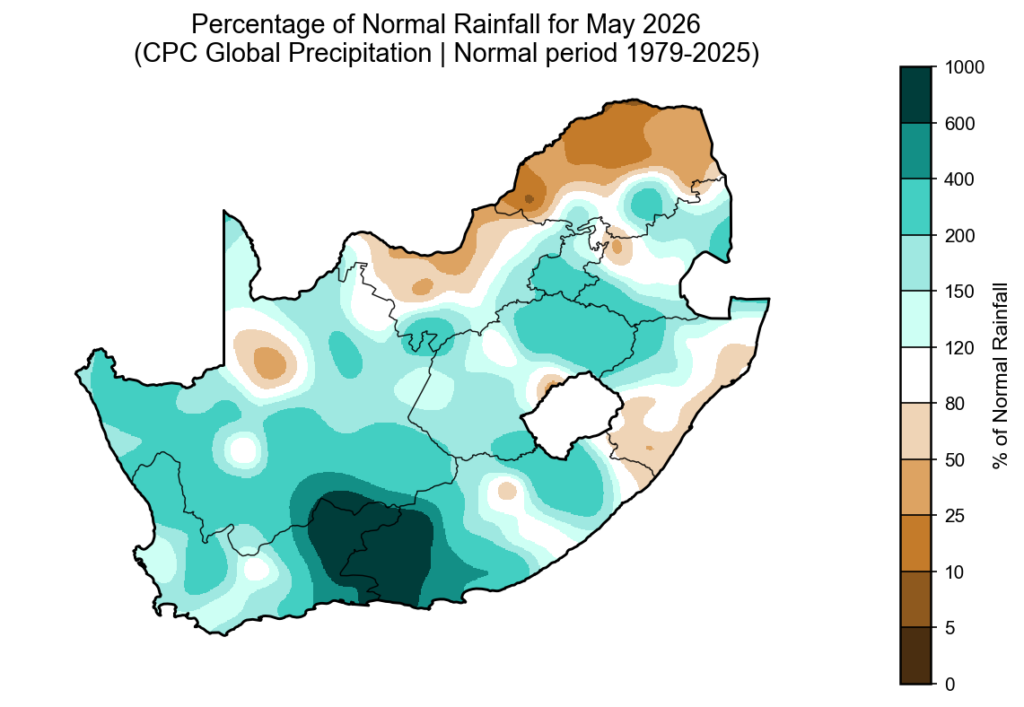
The percentage of normal rainfall for May 2026 clearly shows just how unusual the month was. Large parts of the southern half of South Africa received above-normal rainfall, but the most extreme values were concentrated over the Southern Cape and parts of the Western Cape, where rainfall exceeded 400%, 600% and even 1,000% of normal in places. This means some areas received several times more rain than they would usually expect during May.
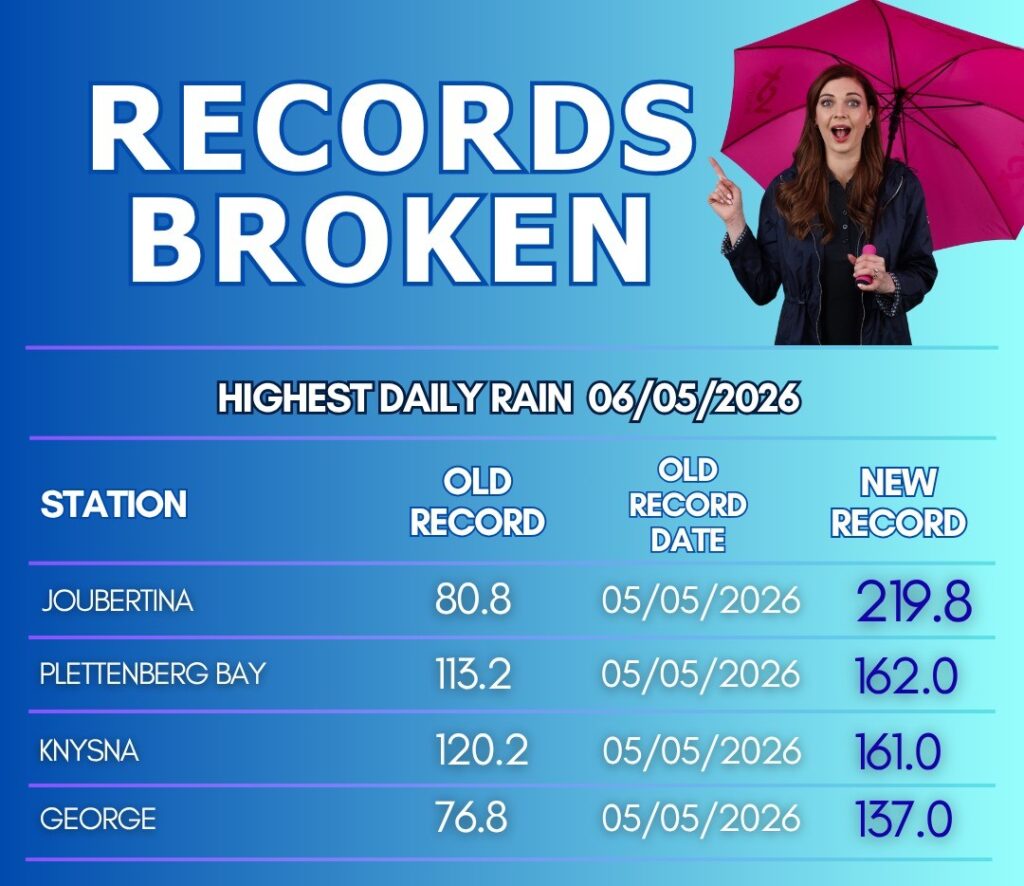
 

This exceptional rainfall was mainly driven by two major weather events. The first was a powerful cut-off low at the beginning of the month, which brought exceptional rainfall to the Southern Cape and Langkloof. Joubertina recorded 220 mm in 24 hours, while one Bokmakierie Holdings weather station in the Krakeelrivier region measured more than 1,000 mm during the event. The flooding around Krakeelrivier was described as some of the worst on record, with experts calling it a one-in-100-year rainfall event.
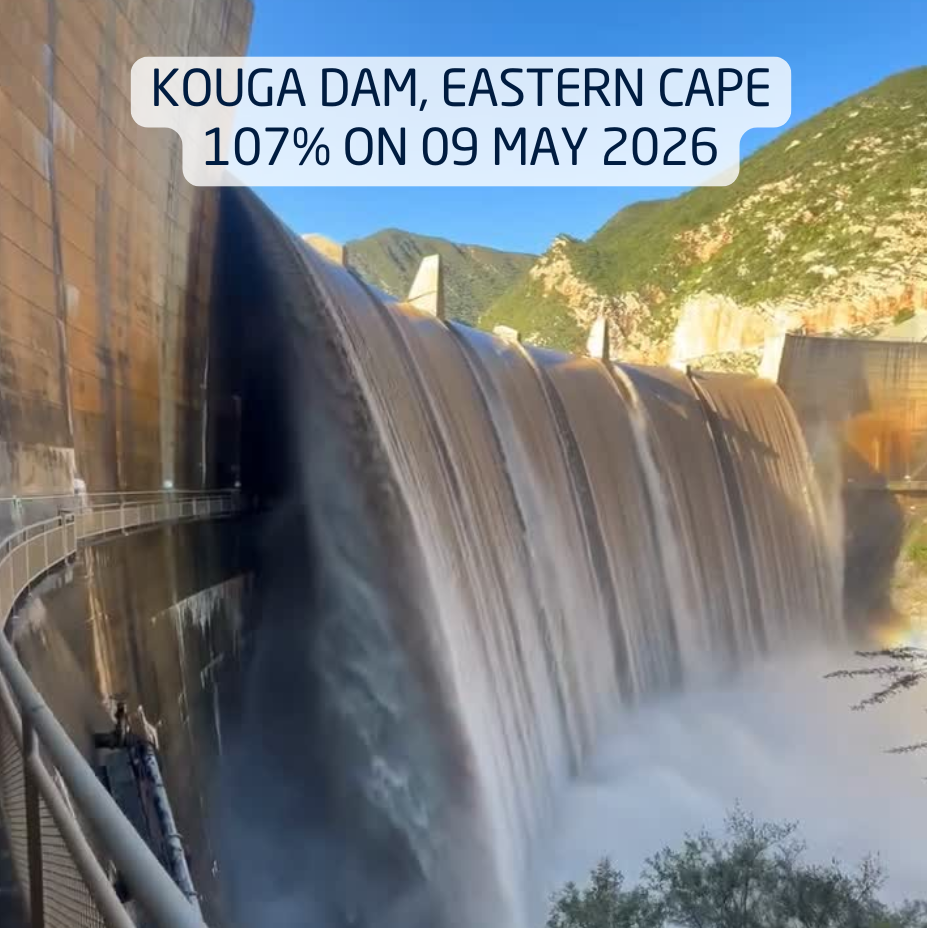
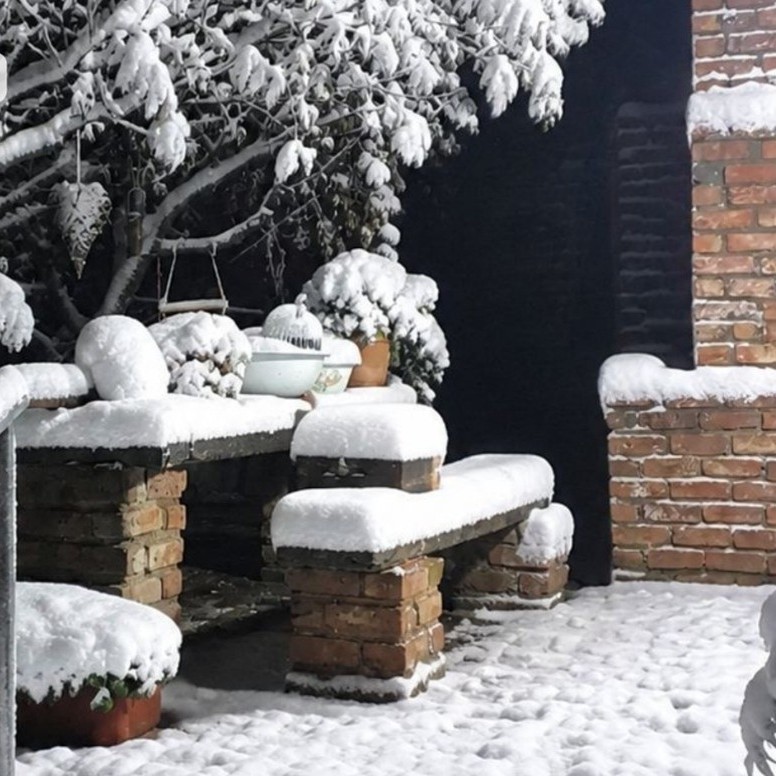
This system also caused dramatic dam level rises, with several dams recovering rapidly. Kouga Dam overflowed on 7 May, showing just how widespread and intense the rainfall was. Very cold air behind the system also brought widespread snow to parts of the Karoo and higher-lying areas.
The second major event followed shortly afterwards, when two strong cold fronts reached the Western Cape from 10 May. Ceres recorded 333.2 mm of rain in 24 hours on 11 May, breaking its highest daily rainfall record since measurements began in 1955. Ceres normally receives around 80 mm of rain during May, but by the end of the month, more than 500 mm had been recorded. This means the town received more than six times its normal May rainfall.

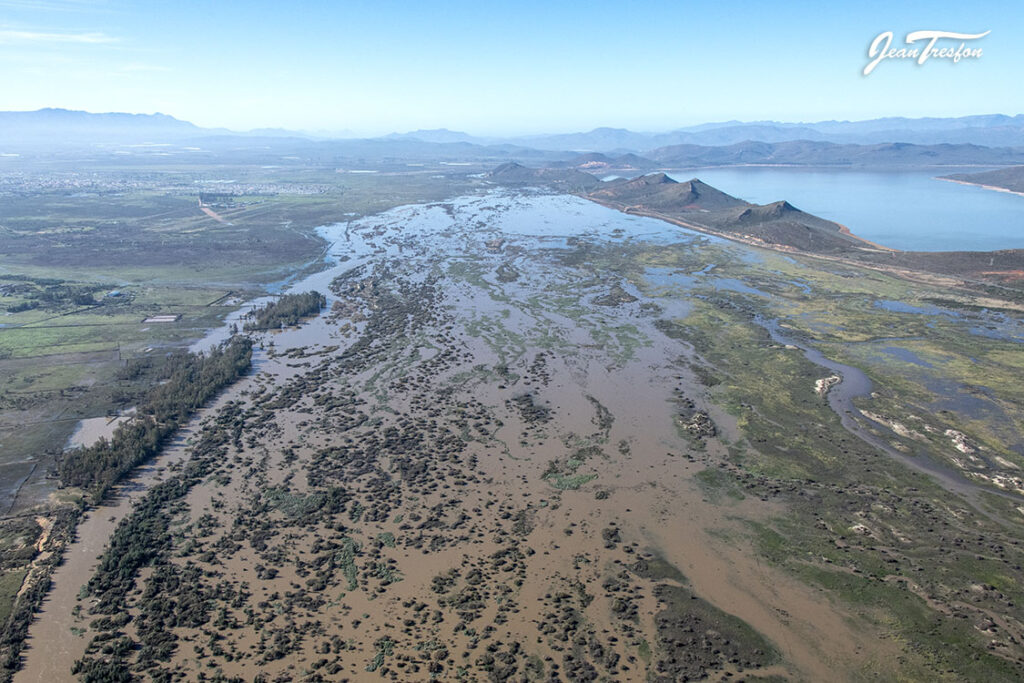
Runoff from the mountains caused the Breede River to rise rapidly. The flood levels recorded near Swellendam suggest that this was likely one of the largest Breede River floods in more than a century, and possibly the biggest since 1925.

Approaching Brandvlei Dam, the Breede River expanded to more than 1 km wide (above left). At the Diepsak Farm area there was massive damage to the farmlands, with whole orchards still underwater (above right).

Together, these two events defined May 2026: a month of broken rainfall records, historic flooding, rapid dam recovery and widespread snow.

ENSO Outlook

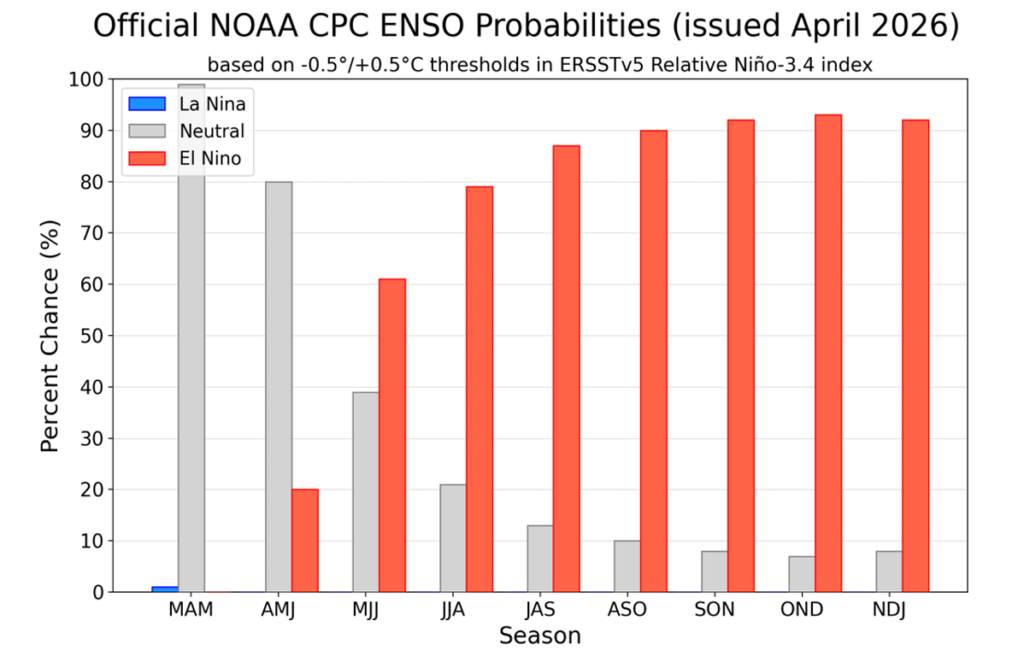
We are currently still in ENSO-neutral conditions, but the latest ENSO probability forecast from the National Oceanic and Atmospheric Adminstration (NOOA), the US government’s official national weather service, is showing a strong signal for El Niño development later this year.

According to the forecast, there is an 82% chance of El Niño conditions developing during May to July, increasing to an almost 100% chance by spring.

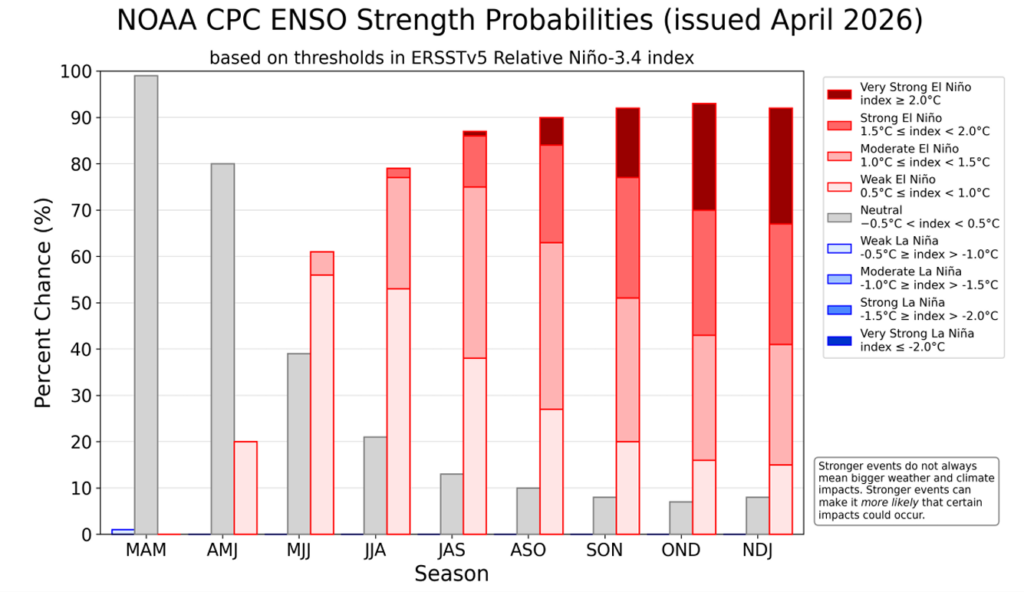
The NOAA ENSO strength forecast also shows a notable signal for a stronger event later in the year. For the November 2026 to January 2027 period, it indicates about a 1-in-3 chance of a strong El Niño developing, and another 1-in-3 chance of a very strong El Niño developing. Combined, this suggests roughly a 2-in-3 chance of either a strong or very strong El Niño during that period.

So, while the signal for El Niño is currently very strong, it is important to remember that this is not a direct drought forecast. Local rainfall patterns are also influenced by many other factors.

For now, the key message is to keep a close eye on how the forecast develops over the coming months. Seasonal guidance is useful, but shorter-term forecasts will remain especially important when it comes to planning around rainfall, agriculture and water risks.

Seasonal Outlook: June, July, August (Winter)

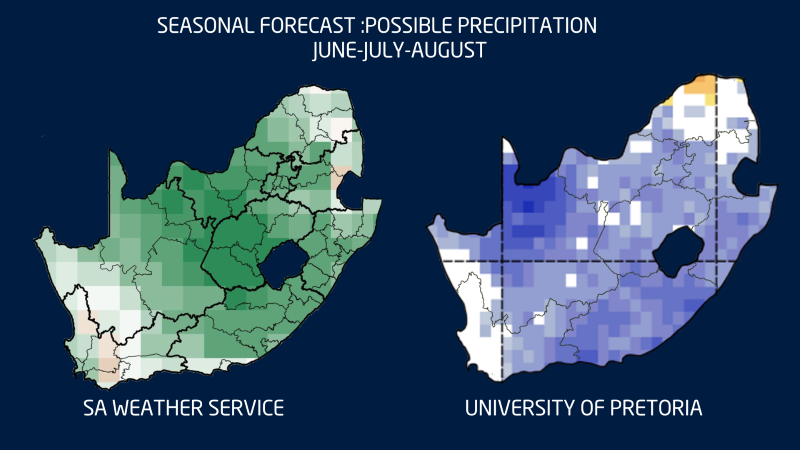
The seasonal precipitation outlook for June, July and August shows a broadly similar picture from both the SA Weather Service and the University of Pretoria. Both forecasts indicate enhanced probabilities for above-normal rainfall across large parts of the summer rainfall region during winter, especially over the central and eastern interior. This suggests that parts of the country that are usually drier during winter could still receive some rainfall during this period.

The winter rainfall region, however, does not show the same strong or consistent signal. While some areas may still receive frontal rainfall during the season, the outlook does not point to a clear, widespread above-normal rainfall signal over the south-western Cape.

Overall, the two forecasts support a similar broad message: a wetter-than-usual winter signal over much of the summer rainfall region, with more uncertainty over the winter rainfall region.
Seasonal Outlook: August, September, October (Spring)

When looking at the late winter to early spring seasonal outlook for August, September and October, the two forecasts start to show more noticeable differences.

The SA Weather Service forecast still indicates a wetter signal across large parts of the interior, especially over the central parts of South Africa. However, the University of Pretoria forecast shows a more mixed picture, with indications of drier conditions over parts of the west and east, while some areas along the east coast still show a wetter signal.

This difference between the two forecasts highlights the uncertainty that remains for the late winter and early spring period. This is especially important as El Niño is expected to develop later this year, which could influence rainfall patterns as we move closer to spring and summer.
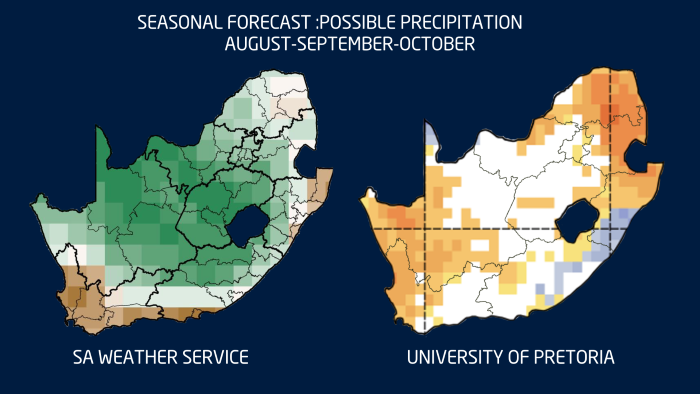
For now, the key message is that the seasonal signal is not yet fully consistent. It remains important to monitor the forecast closely over the coming months and to use shorter-term forecasts for more detailed planning.

Latest Dam Levels

The impact of the May rainfall was also clearly reflected in dam levels across the Western and Southern Cape.

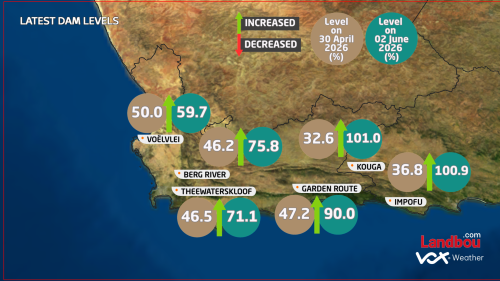
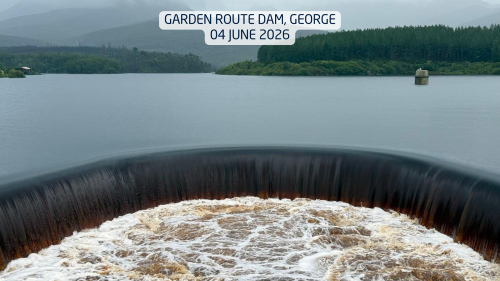
By 2 June 2026, several major dams had shown dramatic increases compared to the end of April. The Kouga Dam rose from 32.6% to 101.0%, while the Impofu Dam increased from 36.8% to 100.9%. The Garden Route Dam also climbed sharply from 47.2% to 90.0%.

Further west, Theewaterskloof Dam increased from 46.5% to 71.1%, Berg River Dam from 46.2% to 75.8%, and Voëlvlei Dam from 50.0% to 59.7%.

These increases show just how significant the rainfall was during May. While the flooding caused severe damage in many areas, it also brought a major turnaround for several dam systems that had been under pressure earlier in the year.
Why it is still too early to make drought predictions for South Africa

After one of the better rainfall seasons so far across parts of South Africa’s summer rainfall areas, a new concern is starting to draw attention: the possibility of a strong, or even ‘Super’, El Niño later in 2026. This has already raised concern among farmers, agricultural businesses, water planners and other weather-sensitive industries. However, says Vox Weather Meteorologist Michelle du Plessis, it is important to approach the topic carefully.

While the chance of El Niño developing later this year is increasing, it is still too early to make direct drought predictions for South Africa. At this stage, the best message is one of awareness and preparation, not panic. We unpack this in the article.

What is El Niño?

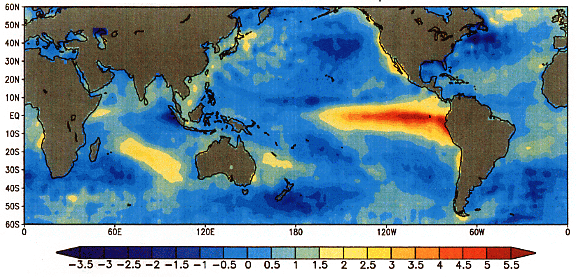
El Niño forms part of the El Niño-Southern Oscillation, commonly known as ENSO. ENSO is a natural climate pattern linked to changes in sea surface temperatures and atmospheric pressure across the central and eastern equatorial Pacific.

During El Niño, sea surface temperatures in the central and eastern equatorial Pacific Ocean become warmer than normal. This warming can influence global weather patterns by shifting large-scale atmospheric circulation. 

In southern Africa, El Niño is often associated with a greater chance of hotter and drier conditions during the summer rainfall season, especially over the interior summer rainfall regions.

However, El Niño does not affect every country or every season in the same way. It also does not automatically mean that drought will occur.

What are the latest forecasts showing?

According to the latest outlook from the US Federal Agency, the National Oceanic and Atmospheric Administration (NOAA), ENSO-neutral conditions are currently present, but El Niño is likely to develop during May to July 2026. NOAA gives a 61% chance of El Niño emerging during this period and continuing through at least the end of 2026.

NOAA also indicates a roughly one-in-four chance that the event could become very strong later in the year, but notes that this depends on whether the atmospheric conditions over the equatorial Pacific continue to support further strengthening.

The World Meteorological Organization (WMO) has also highlighted that ENSO-neutral conditions are expected in the short term, while the probability of El Niño increases later in 2026. WMO’s earlier update indicated around a 60% chance of neutral conditions during May to July, with the chance of El Niño rising to around 40% during that same period.

Here at home, the University of Pretoria’s Seasonal Forecast Worx April 2026 update also points towards the possible development of a strong El Niño state towards the end of 2026.

This means there is growing agreement that El Niño may develop later this year, but there is still uncertainty about how strong it will become and how directly it will affect South Africa.

What does ‘Super El Niño’ mean?

The term ‘Super El Niño’ is often used in the media to describe an exceptionally strong El Niño event. In scientific discussions, a very strong El Niño is usually linked to sea surface temperature anomalies in the Niño 3.4 region reaching around +2.0°C or more.

However, ‘Super El Niño’ is not always used consistently. It can sound dramatic, and it can create the impression that severe drought is already guaranteed. That is not the case.

A strong El Niño increases the probability of certain climate impacts, but it does not guarantee the same outcome in every country. For South Africa, the strength of El Niño is important, but it is not the only factor that determines rainfall.

Too early to make drought predictions for South Africa

It is still too early to directly link the expected El Niño to a specific drought outcome for South Africa.

One reason is that ENSO forecasts are generally less reliable during the late autumn and winter months. Forecast confidence usually improves from around August and September, when the Pacific Ocean and atmosphere are more clearly coupled and the signal for the coming summer rainfall season becomes stronger.

This is especially important for South Africa, because the main ENSO-related impacts are usually felt during the summer rainfall season, from around October or November through to March. The current winter period is not expected to be significantly influenced by the developing El Niño signal.

For this reason, any strong statements about drought over South Africa should be treated with caution at this stage. It is more responsible to say that the risk of hotter and drier summer conditions may increase if a strong El Niño develops, but it is not yet possible to confirm the timing, severity or regional detail of those impacts.

South Africa’s rainfall is influenced by more than ENSO

Although El Niño is an important climate driver, South Africa’s rainfall is influenced by several other factors as well.

These include the position of high-pressure systems, moisture transport from the tropics and Indian Ocean, cut-off lows, tropical-temperate cloud bands, regional circulation patterns, sea surface temperatures near southern Africa, and shorter-term weather systems.

This means that even during El Niño years, rainfall can still vary significantly from one region to another. Some areas may experience long dry spells, while others may still receive important rainfall events.

It is also important to remember that only the summer rainfall regions of South Africa are typically more directly influenced by ENSO. The winter rainfall region, especially the Western Cape, is not affected in the same way during winter.

What can we learn from past strong El Niño events?

Historically, South Africa has experienced different outcomes during strong El Niño events.

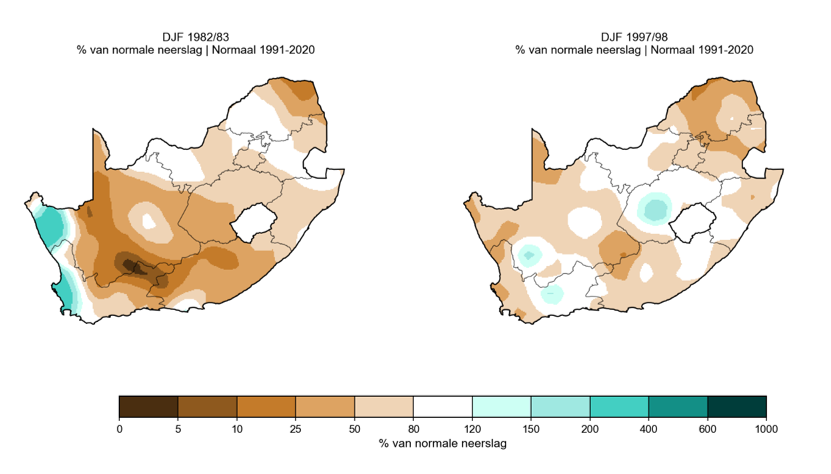
The 1982/83 El Niño was linked to severe agricultural impacts and is remembered as one of the more damaging events for crops. However, the 1997/98 event, although globally one of the strongest El Niño events on record, did not produce the typical widespread hotter and drier summer season over South Africa in the same way.

This shows why we cannot simply say “strong El Niño equals drought”. The relationship is important, but it is not perfect.

El Niño increases the risk of certain conditions, but the final impact depends on how it interacts with other climate drivers during the season.

What could this mean for South Africa if a strong El Niño develops?

If a strong El Niño develops and persists into the 2026/27 summer rainfall season, South Africa’s summer rainfall areas may face an increased risk of warmer and drier conditions compared with normal.

  • For daily life, this could mean a greater chance of heatwaves, higher water demand, increased fire-weather risk in some areas, and pressure on household and municipal water use.
  • For agriculture, the main concern would be the timing and distribution of rainfall during the planting and growing season. Even if seasonal rainfall totals are not extremely low, poor rainfall timing, long dry spells between rainfall events, or very hot conditions during sensitive crop stages can still place crops and livestock under pressure.
  • For weather-sensitive industries such as mining, construction, tourism, logistics and supply chains, a hotter and drier summer could increase operational challenges. These may include heat-related working conditions, dust, water-use pressure, veld fire risk, and possible knock-on effects on agricultural production and food prices.

However, these remain possible risks, not confirmed outcomes.

What should farmers and weather-sensitive industries do now?

The key message is to prepare practically, but not to panic.

Farmers should monitor seasonal updates closely over the next few months, especially from August and September onwards when confidence in the summer outlook should improve. It may also be useful to start reviewing water availability, irrigation planning, planting decisions, fodder reserves, livestock heat-stress plans and financial risk strategies.

At the same time, short-term forecasts remain the most useful tool for immediate decision-making. A possible El Niño later in the year does not replace the need to monitor weekly rainfall systems, cold fronts, cut-off lows, heatwaves and severe weather warnings.

Is climate change making El Niño worse?

El Niño is a natural climate phenomenon. It is not caused by climate change. However, it now occurs in a warmer global climate system.

This means that when a strong El Niño develops, it can add to already elevated global temperatures and increase the likelihood of heat-related extremes in some parts of the world. A strong El Niño in a warmer world can therefore have amplified impacts, especially when it comes to temperature.

For South Africa, this means that if a strong El Niño develops, the heat component may be particularly important to monitor during the 2026/27 summer season.

The key message for South Africa

There is growing evidence that El Niño may develop later in 2026, and there is a possibility that it could become strong. However, it is still too early to confirm a ‘Super El Niño’ or make direct drought predictions for South Africa.

The most responsible message is that the risk of hotter and drier conditions may increase for the summer rainfall areas during the 2026/27 summer season, especially from October or November into March, but this risk still needs to be monitored carefully over the coming months.


For now, South Africans should remain informed, follow trusted seasonal updates, and continue to use short-term forecasts for practical day-to-day planning.

A possible strong El Niño is something to watch closely, not something to treat as a guaranteed drought forecast.

We saw eight weather warnings in place recently as a second, and stronger, cold front moved over the south-western Cape in quick succession, bringing damaging winds and disruptive rain. Vox Weather Meteorologist Michelle du Plessis shares a short overview.

(Cover image courtesy of SABC News: Facebook)

Two consecutive cold fronts moved across the south-western parts of South Africa this week (10 to 15 May), bringing widespread heavy rain, damaging winds and major disruptions across parts of the Western Cape.

The first cold front moved through on Sunday the 10th of May, followed by a second and stronger system on Monday the 11th. This second front brought the most intense weather, with heavy rainfall continuing into Tuesday the 12th across several areas.

Widespread Flooding and Disruptions

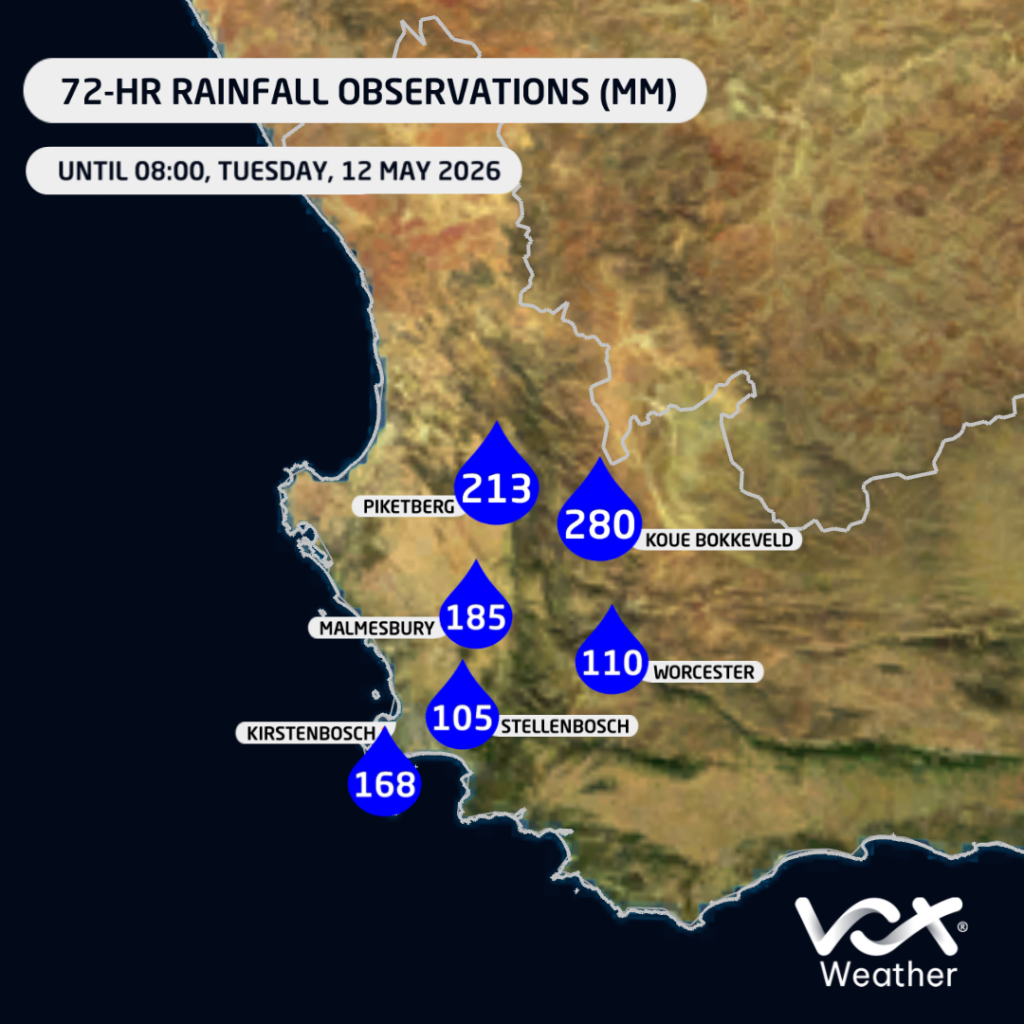
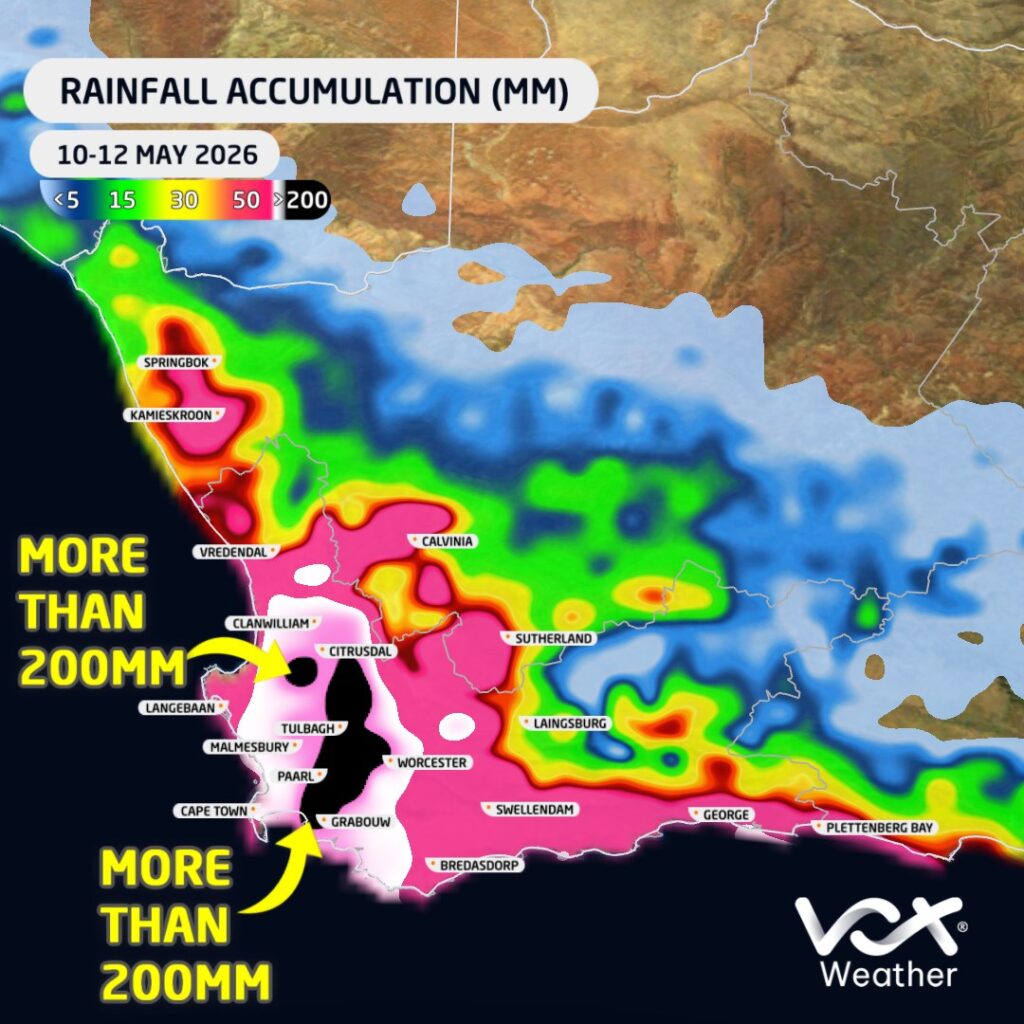
Rainfall totals were particularly significant across the western and south-western parts of the province. Several public reports indicate very high accumulations, including around 213 mm near Piketberg by Tuesday morning, with rain still continuing at the time of the report.

In the Koue Bokkeveld, between Ceres and the Cederberg, some areas reportedly received up to around 280 mm, with ongoing rain, road closures, power outages, limited internet access and cellphone tower disruptions being reported.

Some areas may even have received more than 300 mm, particularly some of the mountainous regions.

These very high totals led to widespread flooding and disruptions, with several schools in the Western Cape closed on Tuesday due to the severe weather conditions.

Damaging Winds

The heavy rain was not the only major concern. Damaging winds were also a significant component of this system.

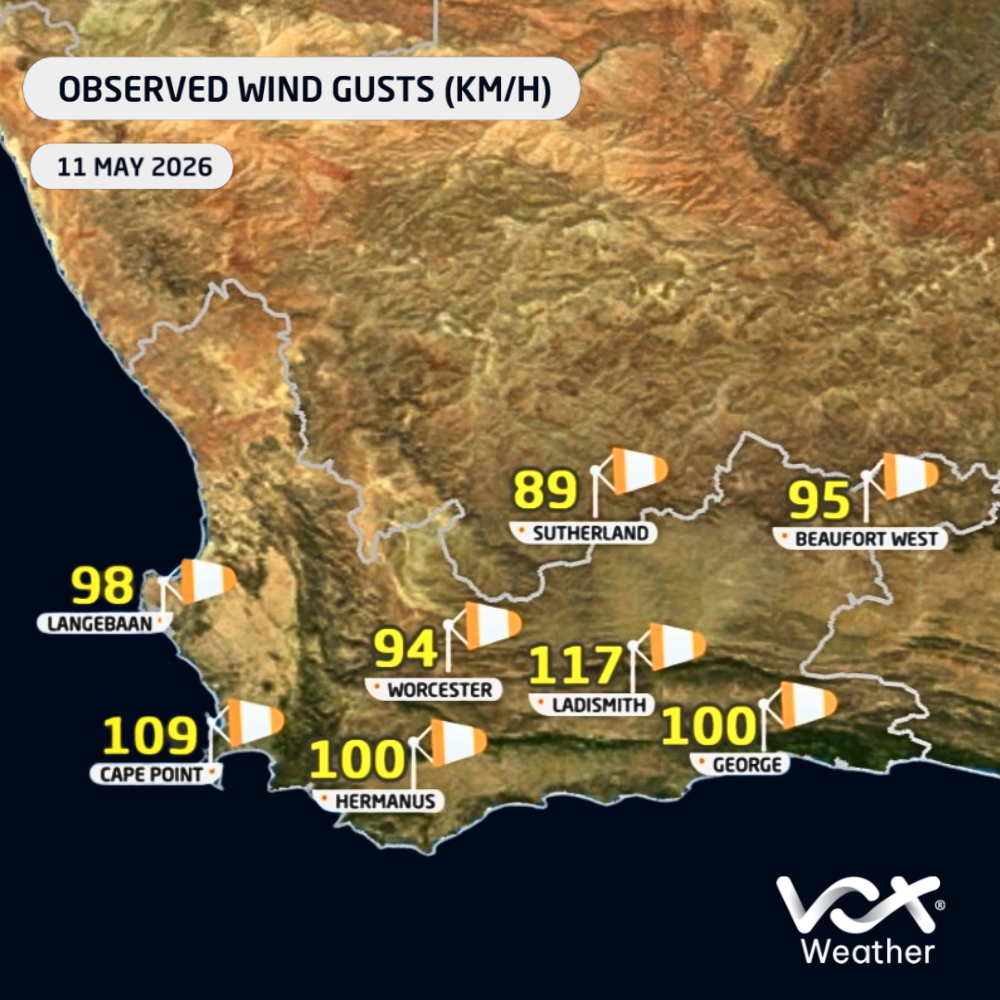
Official 24-hour wind gust observations for Tuesday showed gusts of 117 km/h at Beaufort West and Ladismith, 113 km/h at Ngqura, 109 km/h at Cape Point, 100 km/h at Sutherland, 98 km/h at Dohne, 94 km/h at Hermanus, 93 km/h at Laingsburg, and 91 km/h at both Cape Town AWS and Uitenhage.

Some private weather station reports indicated even stronger gusts, including a reported maximum wind gust of 142 km/h near Piketberg.

These strong winds contributed to widespread damage, including power outages, fallen trees, infrastructure damage and transport disruptions. The closure of the N1 towards Cape Town near Worcester was particularly significant, as it affected a major transport route into the city and likely disrupted the movement of goods and services. A number of flights from the Cape Town and George airports were also affected.

Nature Unleashed

This event highlights the tremendous potential impact of winter cold fronts when multiple systems move through in quick succession. The combination of saturated ground, persistent rainfall, strong winds and rough conditions can quickly lead to flooding, infrastructure damage, travel delays and power supply challenges.

Although strong cold fronts are a normal part of the Western Cape winter rainfall season, this event was particularly significant because of the intensity of the second front, the high rainfall totals over a short period, and the widespread damaging winds.

Conditions are expected to improve from Wednesday as the second cold front moves away from the province. The latest forecast currently indicates dry conditions across most regions of the Western Cape for the rest of the week.